You’re looking for a gynecologist in Westlands. A lawyer in Kampala. A safari tour offers in Arusha. What’s the first thing you do? You open Google and type exactly what you need.
That moment when a potential customer types a search query is where SEO either works for your business or works against it. If your website appears at the top of those results, you get the click, the enquiry, the sale. If it doesn’t, someone else does.
SEO or Search Engine Optimization is the discipline of making sure your business shows up when the people who need you are searching. In 2026, with over 27 million internet users in Kenya alone, and the broader East African digital economy growing at pace, the businesses investing seriously in SEO are compounding an advantage that becomes harder for competitors to close every month.
This guide explains what SEO is, how it actually works, what different types of SEO cover and crucially what it takes to do it well in the specific context of Kenya, Tanzania, Uganda, Rwanda and the wider East African market.
What Is SEO?
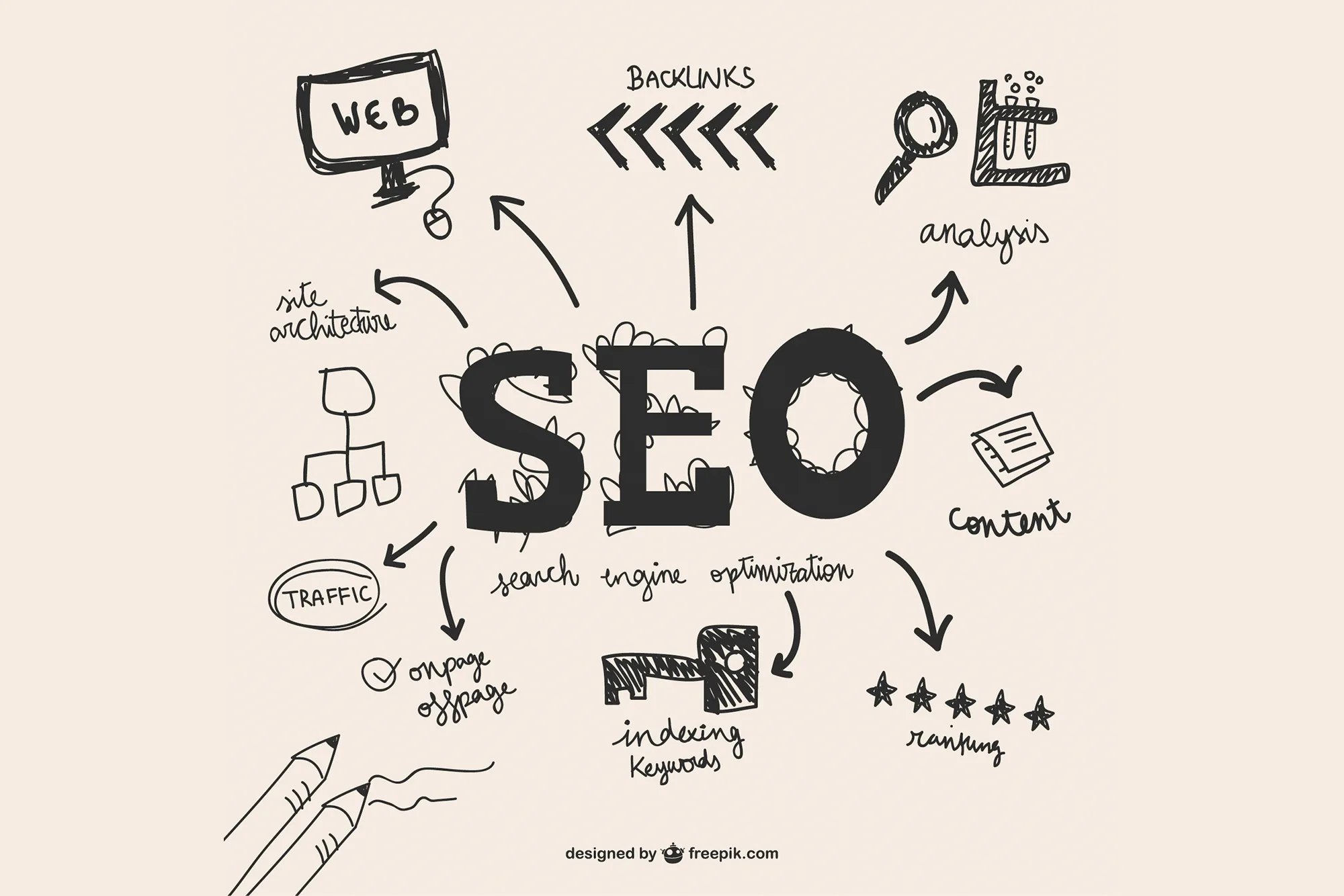
Search Engine Optimization is the process of improving a website’s visibility in organic (non-paid) search results on platforms like Google. When someone searches for a product, service or question, Google’s algorithm decides which websites to show and in what order. SEO is the work of making your website one that Google consistently chooses to rank.
It’s worth being clear about what SEO is not. It is not paying Google to appear in results – that’s Google Ads. It is not a one-time technical fix. And it is not a shortcut. SEO is a sustained, strategic investment that builds over time: the longer and more consistently you do it, the more durable and valuable the results become.
Here’s a practical example. Say you run a aesthetic clinic in Nairobi. Someone in Nairobi opens Google and types “best aesthetic clinic in Nairobi.” Whether your clinic appears in those results and whether it appears at position 1, position 5 or page 2 is determined almost entirely by how well your website has been optimized for local search. That optimization is SEO.
53% of all website traffic globally comes from organic search.
Not social media. Not paid ads. Organic Google results. SEO is the highest-volume, highest-intent traffic channel available to most businesses. (SEO Inc., 2026)
The fundamental reason SEO matters for businesses in East Africa is intent. A person typing “paediatric clinic Nairobi” or “hotel booking Kigali” into Google is not passively scrolling – they are actively looking for something specific. Reaching them at that moment, for free, through organic search, is one of the most powerful marketing positions a business can hold.
How Does SEO Actually Work?
Google’s algorithm processes hundreds of ranking signals every time someone performs a search. While the full algorithm is proprietary and constantly evolving, the signals it assesses fall into three fundamental pillars:
1. Relevance - Does your content answer the query?
Google’s primary goal is to match searchers with the most useful, relevant result for their query. It achieves this by analyzing your content: the words you use, how thoroughly you cover a topic, whether your page answers the specific intent behind the search, and how your content compares to competing pages.
This is why keyword research is foundational to SEO. You need to understand not just what words your audience uses, but what they’re actually trying to accomplish when they search. Someone searching “SEO prices Kenya” has a very different intent from someone searching “what is SEO” and the content that serves each query well looks completely different.
2. Authority - Does Google trust your website?
Relevance alone isn’t enough. Google also assesses the credibility and authority of your website and the primary way it does this is through backlinks: links from other websites pointing to yours. Each credible backlink functions as a vote of confidence. A food blog linking to your clinic, a legal directory listing your law firm, a news article citing your business – these all signal to Google that your site is worth recommending.
In the East African context, building authority often involves earning links from local publications like Business Daily, The EastAfrican, Daily Monitor (Uganda), or The Citizen (Tanzania), as well as from industry associations, local directories, and government-adjacent organisations. These local authority signals matter significantly for regional search visibility.
3. Experience - Is your website good to use?
Beyond relevance and authority, Google measures how users actually experience your website. This includes how fast it loads, how well it works on a mobile phone, how clearly it’s structured, and whether visitors stay and engage or immediately leave. These signals collectively called Core Web Vitals and User Experience signals have become increasingly important ranking factors.
In East Africa, where over 70% of internet access happens via mobile devices and many users are on 4G mobile data rather than fixed broadband, page speed and mobile performance are not optional extras. A site that loads slowly on a Safaricom or MTN data connection is a site that loses customers and rankings.
The Four Types of SEO and What Each Covers
SEO is not a single activity, it’s a combination of disciplines that work together.
Here’s what each type covers and why it matters:
- On-Page SEO - Your own website: Page titles, meta descriptions, headings, keyword placement, internal linking, image alt text, URL structure.
- Off-Page SEO - Across the web: Backlinks from other sites, brand mentions, online reviews, directory listings, PR and digital outreach.
- Technical SEO - Site infrastructure: Page speed, mobile responsiveness, XML sitemap, robots.txt, HTTPS, Core Web Vitals, crawlability, schema markup.
- Local SEO - Maps & local search: Google Business Profile, location pages, local citations (NAP), customer reviews, local keyword targeting.
Effective SEO doesn’t prioritize one type over another, it integrates all four. A site with brilliant content but poor technical infrastructure won’t rank because Google’s crawlers can’t access it properly. A technically perfect site with no backlinks won’t rank because Google doesn’t trust it. All four pillars must be addressed for SEO to deliver consistent, durable results.
A note on Local SEO for East African businesses
For the majority of businesses in Kenya, Tanzania, Uganda and Rwanda: clinics, restaurants, law firms, schools, hotels, salons – local SEO deserves particular attention. When someone in Kisumu searches “hospital near me” or someone in Dar es Salaam searches “accountant Mikocheni”, Google’s algorithm is applying local signals: proximity, Google Business Profile completeness, review volume, and local keyword relevance.
Showing up in the Google Maps Local Pack – the three business listings that appear with a map above organic results — can be transformative for local businesses. The first business listed in the Local Pack captures the majority of local clicks. That position is earned through local SEO, not paid advertising.
SEO in East Africa: What's Different About This Market?
Generic SEO advice written for the UK or US market doesn’t always translate cleanly to East Africa. The search landscape across Kenya, Tanzania, Uganda, Rwanda, and Ethiopia has distinct characteristics that an effective regional SEO strategy must account for:
Kenya
Internet penetration sits at 48%, with search activity split across English and Swahili. The market is highly competitive, particularly in Nairobi, with strong local SEO demand concentrated in healthcare, legal, real estate, and hospitality.
Tanzania
At 32% penetration, Tanzania is growing quickly. Swahili dominates search alongside English, and Swahili-language content represents a genuine competitive advantage given the significant local search volume it commands.
Uganda
Internet penetration is at 30%, with English and Luganda as the primary search languages. The digital economy is largely Kampala-centric and mobile-first. The market is less saturated than Kenya, making early-mover positioning a realistic opportunity.
Rwanda
With 35% penetration, Rwanda punches above its weight digitally. A tech-forward regulatory environment and Kigali’s expanding startup ecosystem are driving rapid growth in digital demand, with search split between English and Kinyarwanda.
Ethiopia
The youngest digital market in the region at 22% penetration. Amharic dominates alongside English, and both Amharic content creation and local-language optimisation remain largely underexplored – representing an open opportunity for early entrants.
Several characteristics are consistent across the region and shape how SEO should be approached:
- Mobile-first is not a trend, it's the reality: Across East Africa, the majority of searches happen on smartphones, often mid-budget Android devices on 4G networks. Page speed on mobile is not a nice-to-have, it's a direct ranking and conversion factor.
- Local language search is underserved: A significant volume of searches in Tanzania happen in Swahili. Amharic search volume is growing rapidly in Ethiopia. Luganda-language content in Uganda is almost entirely uncontested. Businesses that publish quality content in local languages occupy search positions that English-only competitors simply cannot reach.
- Competition is lower outside Nairobi: The SEO landscape in Mombasa, Kisumu, Kampala, Kigali or Dar es Salaam is considerably less competitive than Nairobi CBD. Early investment in SEO in secondary cities can yield disproportionate returns.
- Google Business Profile is dramatically underused: Across most East African cities, a surprisingly high proportion of local businesses either haven't claimed their Google Business Profile or have left it incomplete. For a business that gets this right, the Local Pack visibility advantage is significant.
SEO in 2026: What's Changed and What Still Matters
The fundamentals of SEO: relevance, authority and user experience have not changed. But the environment in which they operate has shifted in ways that are directly relevant to any East African business investing in search visibility.
AI Overviews are reshaping the results page
Google has been rolling out AI-generated summaries (called AI Overviews) above traditional search results for a growing proportion of queries globally. These summaries can reduce click-through rates on informational queries; particularly for broad ‘what is X’ or ‘how to Y’ searches. However, their prevalence in East African markets remains lower than in North America or Europe, and they almost never appear for commercial or local intent queries (“best hotel Nairobi”, “dentist near me”), which is where most business-relevant SEO value sits.
The practical implication: SEO strategies focused on commercial and local search intent remain highly effective. Informational content strategies need to account for AI Overview visibility and focus on depth, specificity, and expertise that AI summaries cannot easily replicate.
E-E-A-T: Experience, Expertise, Authority, Trustworthiness
Google’s quality evaluation framework – E-E-A-T has become a more explicit part of how sites are assessed, particularly in sensitive categories like health, finance, and legal services. For East African businesses in these sectors, demonstrating real-world credentials: author bios, professional qualifications, case studies, client testimonials, and institutional affiliations is increasingly important for sustained ranking performance.
The mobile and speed bar keeps rising
Google’s Core Web Vitals benchmarks are updated periodically, and the performance bar continues to rise. A site that passed speed and usability tests 18 months ago may now fall below acceptable thresholds. Ongoing technical SEO monitoring is not optional, it’s maintenance for a digital asset.
What Professional SEO Actually Delivers for Your Business
Here is what a well-executed, sustained SEO campaign produces, with realistic expectations about timelines:
- Higher search visibility: Your business appears for the keywords your customers are actively searching for; including local, product-specific, and intent-based queries.
- More qualified traffic: SEO traffic is intent-driven. Visitors from organic search are actively looking for what you offer, unlike social media, where you're interrupting someone's feed.
- Better leads and conversions: Traffic that finds you through relevant search queries converts at significantly higher rates than most other channels.
- Compounding returns over time: A well-ranked page continues delivering traffic and leads months and years after the work was done. Unlike paid advertising, the value doesn't stop the moment you stop spending.
- Reduced dependence on paid advertising: Businesses with strong organic rankings can reduce their reliance on Google Ads for visibility - lowering customer acquisition costs as SEO equity builds.
The top 3 organic results capture over 68% of all clicks on a Google search page.
If you’re not in the top 3, the majority of potential customers never reach your website. (First Page Sage, 2025)
Realistic timelines matter here. Genuine SEO results – meaningful ranking movement for competitive terms: typically begin to appear within 3 to 6 months. Local SEO improvements (particularly Google Business Profile optimisation) can appear faster. Building durable authority for competitive industry keywords takes 9 to 18 months of consistent effort. Anyone promising dramatic results in 30 days is oversimplifying, or worse.
How Much Do SEO Services Cost in Kenya and East Africa?
SEO pricing across East Africa varies considerably based on the scope of work, the competitiveness of the industry, and the depth of the strategy. The following factors directly influence cost:
- Industry competition: Ranking for "hotel Nairobi" requires significantly more effort and investment, than ranking for "leather goods Eldoret".
- Website size and current technical state: A large site with deep technical issues requires more initial remediation work before growth-focused optimisation can begin.
- Geographic scope: A campaign targeting a single Nairobi neighbourhood costs less than one targeting Kenya-wide rankings, and significantly less than a pan-East-African strategy.
- Content requirements: Campaigns that include regular content creation (blog articles, landing pages, local content) carry higher ongoing costs but typically deliver stronger, faster results.
At Afrecce Digital Agency, our SEO services start from KES 65,000 per month. Every campaign is custom-scoped, we don’t offer rigid packages, because no two businesses have the same competitive landscape, starting point, or goals. What we do offer is a clear, multi-month strategy with regular reporting so you can see exactly where your investment is going and what it’s delivering.
Think of SEO as capital expenditure, not operating expense. The right comparison is not ‘can I afford this monthly?’ – it’s ‘what is the long-term return on this investment?’ For a business generating consistent organic leads at zero per-click cost, the ROI of SEO typically exceeds any other digital marketing channel over a 12-to-24-month period.
Ready to Build Your Search Visibility in East Africa?
SEO is not a mystery, but it is a discipline and results are not equal across agencies. The difference between generic SEO and a strategy built around your specific market, your competitive landscape, and the search behaviour of your customers in Nairobi, Dar es Salaam, Kampala or Kigali is the difference between ranking and not ranking.
At Afrecce Digital Agency, we combine technical expertise with genuine East African market knowledge to build SEO strategies that deliver real, measurable growth.
For local SEO (Google Business Profile, Maps visibility): improvements can appear in 4 to 8 weeks. For organic keyword rankings in moderately competitive sectors, expect meaningful movement within 3 to 6 months. For highly competitive industries or national rankings, building durable authority takes 9 to 18 months of sustained effort. Any agency promising significant results in 30 days should be treated with scepticism.
Yes, and arguably more so than for large businesses. Small businesses often operate in geographically defined markets where local SEO is highly cost-effective, competition is lower, and the cost-per-lead from organic search compares favourably to paid advertising. A small clinic in Kisumu, a boutique hotel in Arusha, or a law firm in Kigali can all achieve first-page visibility with a well-executed local SEO strategy at a fraction of what it would cost in London or Dubai.
Google Ads places your business at the top of search results immediately, but you pay every time someone clicks, and visibility stops the moment your budget runs out. SEO builds organic rankings over time, as it takes longer to establish, but once your pages rank, the traffic is free, and the position is maintained through ongoing optimization rather than ongoing spend. Most businesses benefit from combining both: Ads for immediate visibility, SEO for sustainable, compounding growth.
For the basics: optimizing your Google Business Profile, writing helpful blog content, and ensuring your website loads quickly – yes. For technical SEO, competitive keyword research, backlink building, and sustained ranking campaigns in competitive markets, the tools, time and expertise required make professional support the more cost-effective choice for most business owners.
The fundamentals are the same, but the execution differs. Competition levels are generally lower outside Kenya, meaning well-optimised content can rank faster and with less backlink investment. Language matters significantly: Swahili content in Tanzania, Luganda in Uganda and Kinyarwanda in Rwanda can access search demand that English-only competitors miss entirely. Local citation building and Google Business Profile optimisation also play out against a different landscape of local directories and publications in each country.
The clearest indicators are: organic traffic (tracked in Google Analytics), keyword ranking positions (tracked via tools like Ahrefs or Google Search Console) and lead or enquiry volume attributable to organic search. Monthly reporting should cover all three. If your agency cannot show you clear data against these metrics, that’s a problem worth addressing.
blog